
Telecom Network Infrastructure Market | Industry Report 2033
Telecom Network Infrastructure Market Summary
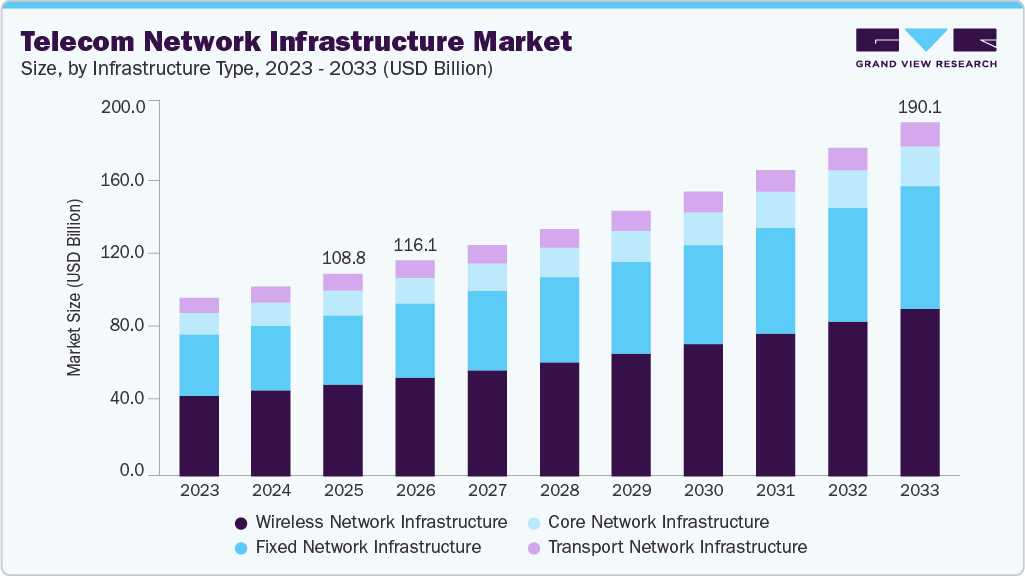
The global telecom network infrastructure market size was estimated at USD 108.81 billion in 2025, and is projected to reach USD 190.13 billion by 2033, growing at a CAGR of 7.3% from 2026 to 2033.The telecom network infrastructure market is gaining momentum, driven by surging 5G deployment, rising demand for high-speed data and seamless connectivity, and advancements in network virtualization and automation.
Key Market Trends & Insights
- The North America telecom network infrastructure market accounted for a 38.4% share of the overall market in 2025.
- The telecom network infrastructure industry in the U.S. held a dominant position in 2025.
- By infrastructure type, the wireless network infrastructure segment accounted for the largest share of 45.5% in 2025.
- By component, the hardware segment held the largest market share in 2025.
- By network technology, the 5G segment held the largest market share in 2025.
- By end user, the telecom operators segment dominated the market in 2025.
Market Size & Forecast
- 2025 Market Size: USD 108.81 Billion
- 2033 Projected Market Size: USD 190.13 Billion
- CAGR (2026-2033): 7.3%
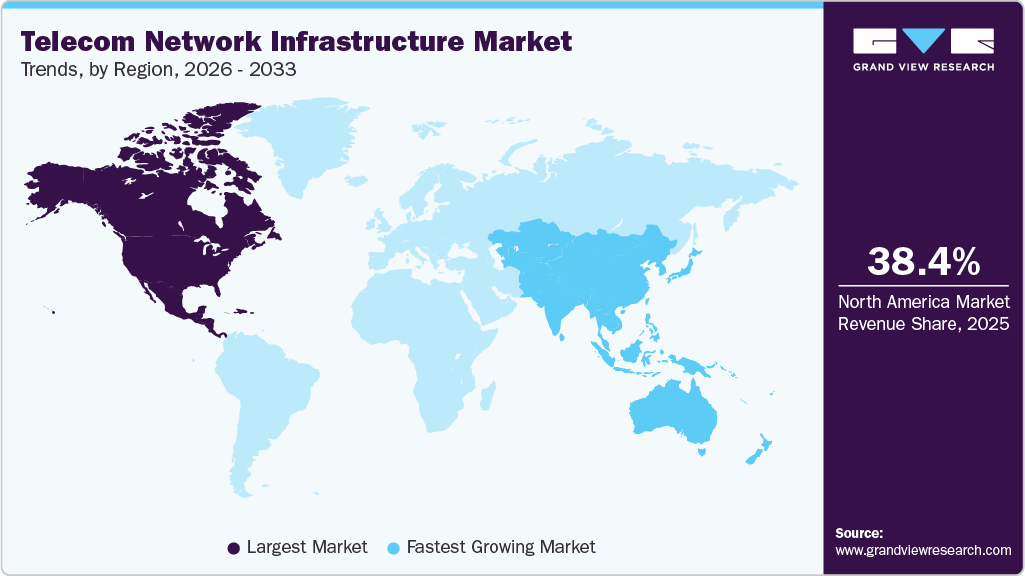
- North America: Largest market in 2025
- Asia Pacific: Fastest growing market
Telecom operators and internet service providers are investing heavily in upgrading their networks to meet growing consumer and enterprise demands, while the expansion of cloud services and data centers is further propelling market growth.
The development of smart cities and the integration of AI and edge computing are creating new opportunities to optimize network performance and enhance service delivery. However, high capital expenditure and complex regulatory frameworks remain major challenges, limiting rapid infrastructure expansion in certain regions. Cybersecurity concerns and potential network vulnerabilities also act as key restraints, necessitating robust security solutions alongside infrastructure growth.
The rapid rollout of 5G networks is enabling higher data speeds, lower latency, and more reliable connectivity, fueling demand for advanced network equipment and infrastructure upgrades. For instance, according to the India Brand Equity Foundation, India achieved a significant milestone with 365 million 5G subscribers as of July 2025, representing 35% penetration just three years after the technology’s launch. Similarly, in the United States, the Federal Communications Commission introduced the 5G Fund for Rural America in October 2020, allocating up to $9 billion from the Universal Service Fund to support 5G deployment in underserved rural areas, including USD 680 million for Tribal lands. These initiatives reflect the global emphasis on expanding 5G networks, driving investments in wireless infrastructure, core network upgrades, and transport network modernization to meet rising connectivity demands.
Rising demand for data and connectivity is driving growth in the global telecom network infrastructure market. In India, mobile data traffic reached 17.4 exabytes per month in 2023, growing at a CAGR of 26% over the past five years, while the average monthly data consumption per user rose to 24.1 GB. Ericsson projects that per-smartphone monthly data use will increase from 29 GB in 2023 to 68 GB by 2029. Globally, the surge in remote work, IoT adoption, and data-intensive applications such as AI and immersive technologies is further accelerating the need for high-speed, reliable networks. This growing demand is prompting telecom operators and internet service providers to invest heavily in upgrading wireless, core, and transport network infrastructure to ensure seamless connectivity and support increasing bandwidth requirements.
Advancements in network virtualization and automation are transforming the telecom network infrastructure market by enabling more flexible, scalable, and efficient network management. Technologies such as software-defined networking (SDN) and network functions virtualization (NFV) allow operators to dynamically allocate resources, optimize traffic, and reduce operational costs. Automation tools improve service deployment speed, fault detection, and network maintenance, enhancing overall performance. These innovations are critical for supporting the growing demand for high-speed connectivity, 5G services, and emerging applications, including IoT and edge computing.
The advancement of smart cities represents a powerful opportunity for the telecom network infrastructure market. Cities such as Seoul (with 5G‑enabled traffic systems), Barcelona (using 5G sensors for environmental monitoring), and Helsinki (deploying smart lamp‑pole networks) are leading examples. In India, Chennai Smart City is investing ~USD 440 million (INR 3,444 crore) into smart mobility, energy, and technology infrastructure. Telecom providers stand to benefit by supplying dense 5G networks, edge computing, and fiber broadband to support IoT, AI analytics, and city-wide digital services.
Regulatory hurdles continue to challenge the growth of the telecom network infrastructure market. In the U.S., operators face complex Federal Communications Commission (FCC) regulations, including lengthy approval processes for spectrum allocation and tower installations, as well as varied state and local permitting rules. These regulatory complexities can delay network expansion, particularly for 5G and fiber deployments in urban and rural areas. Also, compliance with environmental and zoning regulations further increases operational costs and project timelines. Such challenges slow the rollout of advanced telecom infrastructure, elevate capital expenditure risks, and require operators to navigate multi-layered legal frameworks to successfully expand and modernize their networks.
Infrastructure Type Insights
The wireless network infrastructure segment accounted for the largest share of 45.5% in 2025 and is expected to grow at the fastest CAGR during the forecast period, driven by the rapid expansion of 5G networks, rising mobile data consumption, and the growing demand for seamless connectivity across urban and rural areas. Telecom operators are prioritizing upgrades to radio access networks, small cells, and massive MIMO deployments to meet the bandwidth and low-latency requirements of modern applications. The segment is further supported by government initiatives promoting digital inclusion and rural connectivity. Companies are focusing on strengthening domestic capabilities and advancing network technologies; for instance, in September 2025, BSNL, in collaboration with C-DOT, Tejas Networks, and TCS, launched India’s first fully indigenous 4G (5G-ready) network with nearly 98,000 towers, enhancing rural connectivity and laying the groundwork for India’s 6G ambitions under the Viksit Bharat 2047 vision
The fixed network infrastructure segment is expected to grow at a significant CAGR from 2026 to 2033, driven by increasing demand for high-speed broadband connectivity and the expansion of fiber-optic networks across urban and rural regions. The rising adoption of cloud services, video streaming, and remote work solutions is accelerating the need for robust, reliable fixed-line networks. Telecom operators and internet service providers are investing in fiber-to-the-home (FTTH) and next-generation broadband deployments to meet growing consumer and enterprise bandwidth requirements.
Component Insights
The hardware segment accounted for the largest share in 2025. Factors such as the increasing investments in network equipment, expanding 5G deployments, and the need for high-capacity data transmission are fueling the segment’s growth. Telecom operators are focusing on upgrading base stations, antennas, routers, switches, and optical transport equipment to support higher bandwidth and low-latency connectivity. Also, the rollout of fiber-optic networks and the expansion of data centers are fueling demand for advanced networking hardware.
The software segment is expected to grow at a significant CAGR during the forecast period, driven by increasing adoption of network virtualization and automation, and the rising demand for intelligent network management solutions. Operators are leveraging software-defined networking (SDN), network functions virtualization (NFV), and AI-enabled analytics to optimize network performance, improve scalability, and reduce operational costs. Key companies focusing on this segment include Ericsson, Nokia, and Huawei. For instance, in October 2023, Ericsson introduced a 5G Standalone (SA) software toolkit featuring Massive MIMO, advanced RAN slicing, time-critical communication, and 5G Core capabilities. The toolkit enables operators to deliver premium, low-latency, high-throughput services such as XR, mobile gaming, and remote operations, reinforcing Ericsson’s role in advancing experience-based network performance.
Network Technology Insights
The 5G segment accounted for the largest share in 2025, driven by increasing global investments in next-generation mobile networks and rising demand for ultra-low latency connectivity to support advanced applications. Specific drivers include the expansion of 5G infrastructure in urban and rural regions, and the deployment of Massive MIMO and advanced spectrum management technologies that enhance network capacity and coverage. A major application of 5G is in enabling smart city solutions, including IoT-enabled traffic management and real-time public services. Key companies in this segment include Nokia, Ericsson, and Huawei. For instance, in October 2025, Nokia partnered with Corporación Nacional de Telecomunicaciones (CNT E.P.) to launch Ecuador’s first commercial 5G network, delivering speeds up to 1.5 Gbps, enhancing connectivity, and supporting digital transformation across sectors such as healthcare, education, and smart cities.
The satellite segment is expected to register a notable CAGR from 2026 to 2033. Satellite network infrastructure includes geostationary (GEO), medium Earth orbit (MEO), and low Earth orbit (LEO) satellites used to provide broadband connectivity, IoT services, and remote communication in areas where terrestrial networks are limited. The segment is driven by increasing demand for high-speed internet in remote and rural regions and the growing adoption of LEO satellite constellations for low-latency global coverage. Key applications include connectivity for maritime, aviation, and disaster recovery operations, enabling reliable communication in otherwise inaccessible locations.
End User Insights
The telecom operators segment accounted for the largest share in 2025. Telecom operators rely on advanced network infrastructure to improve operational efficiency, reduce latency, and offer differentiated services such as premium broadband, enterprise connectivity, and digital services, enabling them to remain competitive in increasingly saturated markets. Factors such as the increasing investments in 5G and fiber-optic network deployments, rising demand for high-speed data services, and the need to expand network coverage to urban and rural areas support segment growth. Operators are upgrading wireless, core, and transport network infrastructure to support growing mobile data traffic, IoT applications, and cloud-based services.
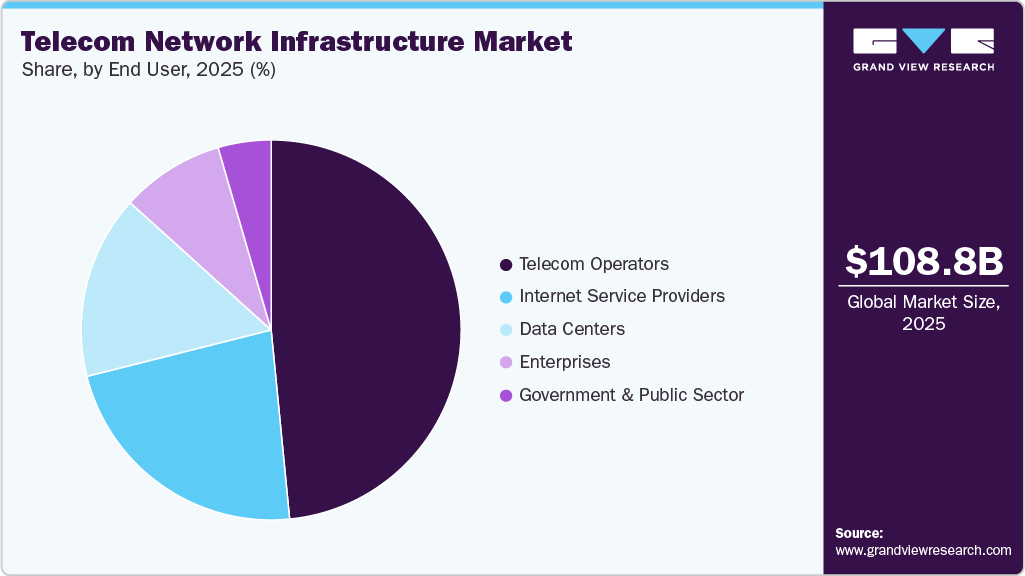
The data centers segment is expected to register a notable CAGR from 2026 to 2033, driven by the growing demand for cloud computing, enterprise IT services, and AI-powered applications. Data centers require robust telecom network infrastructure to ensure high-speed connectivity, low latency, and reliable bandwidth for the storage, processing, and distribution of large volumes of data. The segment is further fueled by the increasing adoption of edge computing, hyperscale facilities, and colocation services, which demand advanced fiber, core, and transport networks.
Regional Insights
The North America telecom network infrastructure market accounted for 38.4% of the global share in 2025, driven by massive 5G rollout initiatives and increasing demand for high-speed broadband across urban and rural areas. Key drivers include substantial capital investments by major telecom operators to upgrade wireless, core, and transport networks, as well as favorable regulatory policies that facilitate network expansion. The Federal Communications Commission (FCC)’s spectrum auctions and programs such as the 5G Fund for Rural America are enabling operators to expand 5G coverage, particularly in underserved areas. Institutional investors are also backing network infrastructure; for example, Northleaf Capital raised USD 2.6 billion to invest in broadband and telecom infrastructure.
Canada Telecom Network Infrastructure Market Trends
The telecom network infrastructure market in Canada is witnessing strong growth, driven by rising demand for high-speed broadband and 5G services across urban and rural regions. According to the Government of Canada, more than USD 7.8 billion was invested in communications networks in 2023, including USD 3.3 billion in fiber-optic deployments, supporting next-generation broadband, cloud services, and IoT applications. Telecom operators are focusing on upgrading wireless and fixed network infrastructure to meet increasing data traffic and enterprise connectivity requirements, while government initiatives continue to incentivize digital inclusion and nationwide network expansion.
The U.S. telecom network infrastructure market held a dominant position in 2025. The telecom network infrastructure market in the U.S. is witnessing significant transformation, driven by rapid 5G network rollout, increasing demand for high-speed broadband and low-latency connectivity, and growing adoption of cloud-native and virtualized network architectures. Telecom operators are investing heavily in upgrading wireless, core, and transport networks to support advanced applications such as IoT, AI analytics, and edge computing.
Key companies in the country focusing on these initiatives include Mavenir, Verizon, AT&T, and Nokia. For instance, in February 2024, Mavenir advanced to the commercial phase of its Open RAN (O-RAN) pilot deployment for Vodafone Idea (Vi), utilizing N78 and N258 mmWave spectrum bands. The initiative, supporting NSA architecture, aims to lower network deployment costs, enhance flexibility, and reflects the growing adoption of cloud-based, vendor-agnostic infrastructure in U.S. telecom networks.
Europe Telecom Network Infrastructure Market Trends
The Europe telecom network infrastructure industry was identified as a lucrative region in 2025. The European telecom network infrastructure market is witnessing significant transformation, driven by accelerating 5G adoption across Member States and significant investments in fiber‑optic broadband. One major driver is the European Union’s funding via the Connecting Europe Facility (CEF Digital), which committed approximately USD 457 million (EUR 420 million) in 2024 and plans an additional USD 939 million (EUR 865 million) through 2027 to support 5G rollout and submarine backbone networks. Another key factor is strong capital expenditure by operators on fixed-line infrastructure, with nearly half of telecom capex directed toward fiber-to-the-home (FTTH).
The Germany telecom network infrastructure market is being shaped by aggressive 5G and fiber-optic expansion. Deutsche Telekom invested around ~USD 5.2 billion (EUR 4.8 billion) in 2024, extending fiber-to-the-home (FTTH) to over 10.1 million homes. Key drivers include strong capital expenditure from incumbents to modernize fixed and mobile networks, rising demand for high-speed broadband across urban and rural areas, and the government-backed push for near-complete 5G population coverage (98% by end-2024). Other major players contributing to infrastructure growth include Nokia and Ericsson.
The UK telecom network infrastructure market is accelerating, supported by a ~USD 13.5 billion (GPB 11 billion) investment from the merged Vodafone-Three entity to deploy nationwide 5G SA and full-fiber networks. Growth is driven by extensive fiber broadband rollout, plans for widespread standalone 5G by 2030, and regulatory support under the government’s Wireless Infrastructure Strategy. Key partners in these initiatives include Ericsson and Nokia, enabling enhanced network coverage, low-latency connectivity, and future-ready digital services.
Asia Pacific Telecom Network Infrastructure Market Industry Trends
The Asia Pacific telecom network infrastructure industry was identified as a lucrative region in 2025 and is expected to grow at the fastest CAGR during the forecasted period. The telecom network infrastructure market in the Asia Pacific is being driven by rapid 5G deployment, increasing demand for high-speed broadband and mobile connectivity, and rising investments in network modernization and fiber-optic infrastructure. According to the India Brand Equity Foundation and the Telecom Regulatory Authority of India (TRAI), India exemplifies these trends, with gross telecom revenue rising from USD 39.22 billion in FY24 to USD 43.42 billion in FY25, and total internet subscribers reaching 979 million by June 2025. Key companies operating in the region include Vodafone Idea (Vi), Samsung Electronics, Huawei Technologies, and ZTE Corporation. For instance, in June 2025, Vodafone Idea (Vi) partnered with Samsung Electronics to commercially launch 5G services in Bengaluru, integrating Massive MIMO radios, virtualized RAN, and vBSC to modernize its multi-generation network infrastructure, enhancing network capacity, efficiency, and flexibility for future-ready operations.
The China telecom network infrastructure market held a significant market share in 2025, driven by widespread 5G‑Advanced deployment, ongoing fiber-optic backbone expansion, and rapid adoption of IoT- and AI-enabled networks. According to GSMA, major operators such as China Mobile, China Unicom, and China Telecom are scaling 5G‑Advanced networks across hundreds of cities nationwide. China Telecom’s 2024 report highlights substantial growth in fiber-optic lines, totaling 72.88 million km, along with large-scale 400G backbone deployments. Concurrently, network infrastructure is increasingly co-built and shared to optimize costs, while cloud-network convergence and edge-cloud integration are being prioritized to enable AI applications and high-speed gigabit access, exemplified by China Telecom’s 10G Cloud-Broadband Initiative.
The Japan telecom network infrastructure market held a significant share in 2025, driven by rapid 5G densification, widespread fiber-to-the-home (FTTH) adoption, and government-backed digital transformation initiatives. Over 87% of fixed broadband lines in Japan were fiber-based in 2024, supporting high-speed connectivity for enterprises, smart cities, and IoT applications. Key players such as NTT, KDDI, and SoftBank are expanding their network hardware and software capabilities, integrating virtualized RAN, edge computing, and next-generation transport networks to support low-latency, high-throughput services.
Key Telecom Network Infrastructure Company Insights
Some of the key players operating in the market include Huawei Technologies Co., Ltd., Nokia Corporation, ZTE Corporation, and Cisco Systems, Inc. among others.
-
Founded in 1987 and headquartered in Shenzhen, China, Huawei Technologies Co., Ltd. is recognized as a global provider of ICT and telecom network infrastructure. End-to-end solutions are offered across radio access, core networks, transport, and optical systems, serving telecom operators, enterprises, and government clients. Network modernization, AI integration, and IoT enablement are actively supported, while cost-efficient and scalable infrastructure deployment is facilitated to meet the growing connectivity and digital transformation needs worldwide.
-
Founded in 1865 and headquartered in Espoo, Finland, Nokia Corporation provides high-performance telecom network infrastructure solutions globally. IP routing, optical transport, fixed access, and data center networking are delivered to service providers and enterprises. Scalable and future-ready digital networks are enabled, while network modernization, cloud integration, and automation solutions are supported. The company’s offerings are utilized to enhance connectivity, operational efficiency, and digital transformation across diverse regions and industries.
Key Telecom Network Infrastructure Companies:
The following key companies have been profiled for this study on the telecom network infrastructure market.
- Huawei Technologies Co., Ltd.
- Nokia Corporation
- Telefonaktiebolaget LM Ericsson (publ)
- ZTE Corporation
- Cisco Systems, Inc.
- Samsung Electronics Co., Ltd.
- NEC Corporation
- Ciena Corporation
- Fujitsu Limited
- Juniper Networks, Inc.
Recent Developments
-
In October 2025, Nokia partnered with Ecuador’s Corporación Nacional de Telecomunicaciones (CNT) to launch the country’s first commercial 5G network, deploying 188 sites across Guayaquil and nearby regions. The rollout, using Nokia’s AirScale RAN, IP routing, and optical transport solutions, marks a key step in Latin America’s telecom infrastructure expansion.
-
In October 2025, NVIDIA partnered with Nokia to develop an AI-RAN platform and invest USD 1 billion to advance AI-native 5G-Advanced and 6G networks. The collaboration aims to integrate NVIDIA’s Arc Aerial RAN computing platform into Nokia’s RAN portfolio, enabling large-scale edge AI inferencing and accelerating the transition toward next-generation telecom infrastructure.
-
In May 2025, Vodafone Idea (Vi) partnered with Ericsson to deploy high-performance Massive MIMO radios (AIR 3268 and AIR 3255) for its 5G rollout in Delhi NCR. The initiative involved upgrading Vi’s existing 4G infrastructure with energy-efficient Ericsson Radio System products to enhance network capacity, reliability, and spectrum efficiency.
Telecom Network Infrastructure Market Report Scope
|
Report Attribute
|
Details
|
|
Market size value in 2026
|
USD 116.15 billion
|
|
Revenue forecast in 2033
|
USD 190.13 billion
|
|
Growth rate
|
CAGR of 7.3% from 2026 to 2033
|
|
Base year for estimation
|
2025
|
|
Historical data
|
2021 – 2024
|
|
Forecast period
|
2026 – 2033
|
|
Quantitative units
|
Revenue in USD Million and CAGR from 2026 to 2033
|
|
Report coverage
|
Revenue forecast, company market share, competitive landscape, growth factors, and trends
|
|
Segments covered
|
Infrastructure Type, Component, Network Technology, End User, Region
|
|
Regional scope
|
North America; Europe; Asia Pacific; Latin America; Middle East & Africa
|
|
Country scope
|
U.S.; Canada; Mexico; UK; Germany; France; China; India; Japan; Australia; South Korea; Brazil; UAE; Kingdom of Saudi Arabia (KSA); South Africa
|
|
Key companies profiled
|
Huawei Technologies Co., Ltd.; Nokia Corporation; Telefonaktiebolaget LM Ericsson (publ); ZTE Corporation; Cisco Systems, Inc.; Samsung Electronics Co., Ltd.; NEC Corporation; Ciena Corporation; Fujitsu Limited; Juniper Networks, Inc.
|
|
Customization scope
|
Free report customization (equivalent up to 8 analysts working days) with purchase. Addition or alteration to country, regional & segment scope.
|
|
Pricing and purchase options
|
Avail customized purchase options to meet your exact research needs. Explore purchase options
|
Global Telecom Network Infrastructure Market Report Segmentation
This report forecasts revenue growth at global, regional, and country levels and provides an analysis of the latest industry trends in each of the sub-segments from 2021 to 2033. For this study, Grand View Research has segmented the global telecom network infrastructure market report based on infrastructure type, component, network technology, end user, and region.
-
Infrastructure Type Outlook (Revenue, USD Million, 2021 – 2033)
-
Wireless Network Infrastructure
-
Fixed Network Infrastructure
-
Core Network Infrastructure
-
Transport Network Infrastructure
-
-
Component Outlook (Revenue, USD Million, 2021 – 2033)
-
Hardware
-
Software
-
Services
-
-
Network Technology Outlook (Revenue, USD Million, 2021 – 2033)
-
2G/3G
-
4G/LTE
-
5G
-
Fiber Broadband
-
Satellite
-
-
End User Outlook (Revenue, USD Million, 2021 – 2033)
-
Regional Outlook (Revenue, USD Million, 2021 – 2033)
Frequently Asked Questions About This Report
b. Some key players operating in the telecom network infrastructure market include Huawei Technologies Co., Ltd., Nokia Corporation, Telefonaktiebolaget LM Ericsson (publ), ZTE Corporation, Cisco Systems, Inc., Samsung Electronics Co., Ltd., NEC Corporation, Ciena Corporation, Fujitsu Limited, Juniper Networks, Inc.
b. Key factors that are driving the market growth include surging 5G deployment, rising demand for high-speed data and seamless connectivity, and advancements in network virtualization and automation. Telecom operators and internet service providers are investing heavily in upgrading their networks to meet growing consumer and enterprise demands, while the expansion of cloud services and data centers is further propelling market growth.
b. The North America telecom network infrastructure market accounted for 38.4% of the global share in 2025, driven by massive 5G rollout initiatives and increasing demand for high-speed broadband across urban and rural areas. Key drivers include substantial capital investments by major telecom operators to upgrade wireless, core, and transport networks, and favorable regulatory policies that facilitate network expansion. The Federal Communications Commission (FCC)’s spectrum auctions and programs such as the 5G Fund for Rural America are enabling operators to expand 5G coverage, particularly in underserved areas. Institutional investors are also backing network infrastructure, for example, Northleaf Capital raised USD 2.6 billion to invest in broadband and telecom infrastructure.
b. The global telecom network infrastructure market size was estimated at USD 108.81 billion in 2025 and is expected to reach USD 190.13 billion in 2033.
b. The global telecom network infrastructure market is expected to grow at a compound annual growth rate of 7.3% from 2026 to 2033 to reach USD 190.13 billion by 2033.
link