
Resilience assessment of urban connected infrastructure networks
Data sources
This paper investigated a county in Jiangxi Province, China as the data support of the study. According to “China’s Administrative Division Data”, Arcgis software was used to draw a district map of a county in Jiangxi Province, China, as shown in Fig. 3.

Where the data come from (This image was drawn by the author using ArcGIS software (version 10.8, https://www.esri.com/en-us/arcgis/products/arcgis-desktop/resources)).
Taking a county in Jiangxi Province as the research background, we focus on the five core infrastructures in the county: power, water supply, transportation, communication and service systems. By carefully analyzing the state of each system when it operates independently, we can obtain the topology and key parameters of the corresponding power network, water supply network, transportation network, communication network and service network, as shown in Fig. 4.

Distribution of network nodes for each infrastructure system (This image was drawn by the author using ArcGIS software (version 10.8, https://www.esri.com/en-us/arcgis/products/arcgis-desktop/resources)).
From Fig. 4: The power system network consists of 39 nodes with 48 connected edges. The water supply system network consists of 14 nodes and 13 connected edges. The transportation system network consists of 21 nodes and 31 connected edges. The communication system network consists of 18 nodes and 23 edges. The service system network consists of 18 nodes with 21 edges.
Parameter analysis of urban linked infrastructure networks
By analyzing the individual infrastructure systems in the independent case, it is possible to further obtain the topology of the independent power network, water supply network, transportation network, communication network, and service network, as shown in Fig. 5 below.

Network topology of each infrastructure system.
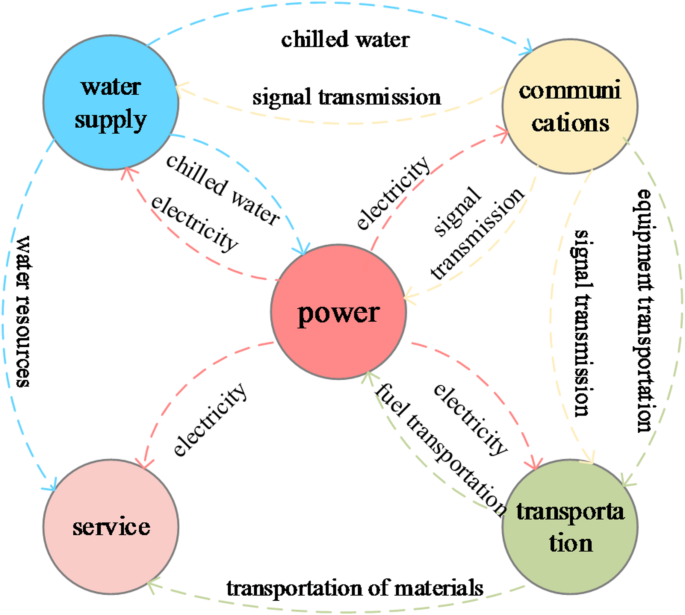
The operation of the four major systems of water supply, transportation, communication and services are dependent on the support of the power system, as evidenced by the existence of a directed connection from the power node between the network nodes of the systems and their geographically neighboring power network nodes. Further, the service system is dependent on the water supply system, and the service network nodes form directed connections from the water supply nodes with neighboring water supply network nodes. Meanwhile, the traffic control of the transportation system is supported by the communication system, and there are directed connections between the transportation network nodes and neighboring communication network nodes directed from the communication nodes to the transportation network nodes. An overview of the connectivity edges generated by these correlations is shown in Supplementary Table 1 in the supplementary section.
Combining formulas (1)–(9) and the connections between network nodes, we obtained the calculation results of degree centrality, betweenness centrality, closeness centrality, eigenvector centrality, and clustering coefficients for nodes in each sub-network, as shown in Fig. 6.

Network node parameters for each infrastructure system.
As can be seen in Fig. 6, after the association of the infrastructure network, the node centrality indices of each subsystem level are similar. The degree centrality is around 0.05, the betweenness centrality is nearly 0.03, and the closeness centrality is about 0.25, indicating a balanced nature. However, the clustering coefficient of the power network nodes is significantly higher than that of the overall network. This reveals the existence of small groups of tightly connected nodes around the power nodes, emphasizing their core and bridging roles in the network. The remaining subsystems are tightly connected due to the power network, confirming the key position of the power network in the flow of energy and information. This highlights the extreme importance of maintaining the stability of the power system for the security and efficiency of the overall network.
Cascading failure processes in urban linked infrastructure networks
Overall correlation network failure analysis
Referring to the steps outlined in the previous section titled “Network cascade failure analysis of urban linked infrastructure networks,” we obtained the reliability of the overall network under three different types of attacks: random attack, degree attack, and betweenness attack. These results are presented in Fig. 7.

Reliability of the overall network.
From Fig. 7, it can be seen that the network reliability significantly plummets when the node failure probability is between 0.2 and 0.45 under the three simulated attack scenarios. In comparison, it is found that the node failure probability required for a mutation is higher for degree attack than for betweenness attack. This indicates that the reliability performance of the urban connected infrastructure network is ranked in the following order among the three modes of attack: random > degree > betweenness attack. This illustrates how different attack tactics can have varying effects on network stability.
Failure analysis of 2-layer coupled networks
The power network plays a central role in the overall architecture and is closely connected to the four major subsystems: water supply, transport, communication, and service. To deeply analyze the resilience of different connected networks, we simulate the failure evolution of the independent power network, power-water supply network, power-transportation network, power-communication network, and power-service network under three scenarios: random attack, degree attack, and betweenness attack. These simulations are conducted using the methodology described in the previous paper titled “Network cascade failure analysis of urban linked infrastructure networks.” The results of these simulations are shown in Fig. 8.

Layer 2 network failure process.
From Fig. 8, it can be seen that network reliability varies more continuously under random attacks, while the two intentional attacks—degree and betweenness—trigger significant fluctuations and exhibit second-order characteristics. As a comprehensive assessment, the network is the most robust under random attacks, followed by degree attacks, and the most vulnerable under betweenness attacks. When comparing the single-layer power network to the two-layer coupled network, the latter is significantly less reliable than the former. Further analysis of different attack strategies reveals that the same network performs better under random attacks than under any deliberate attack pattern, highlighting the positive impact of randomness on network stability.
Failure analysis of 3-layer coupled networks
Building on this study, we further focus on the complex system comprising three key sub-networks: power, communication, and transport. Using the methodology described in the previous section titled “Network cascade failure analysis of urban linked infrastructure networks,” we simulate the dynamic process of the three-layer network evolving with node failure under three attack strategies—random attack, degree attack, and betweenness attack. The results are shown in Fig. 9.

Layer 3 network failure process.
According to Fig. 9, the single power network exhibits the highest reliability, followed by the two-tier network, while the three-tier network has the lowest reliability. Therefore, the reliability of the urban associated infrastructure network decreases as the number of network layers increases. In other words, the increase in system complexity, along with the increase in the number of sub-networks, tends to weaken the robustness of the overall network, thereby intensifying the risks faced by the urban infrastructure system.
Analysis of the results of the resilience assessment of the urban linked infrastructure network
Calculation of resistance capacity
Based on Eq. (19), the resistance capacity of the initial network and the resistance capacity of each infrastructure subsystem can be calculated, as shown in Fig. 10.

Network efficiency of city-associated infrastructure.
From Fig. 10, it can be seen that the network efficiency E dynamically changes under different attack strategies: both deliberate attacks (degree and betweenness) trigger a sudden change in efficiency, while under random attacks, the efficiency changes are relatively smooth and continuous. The initial resistance capacity value of the city’s infrastructure network is calculated to be 0.371, indicating that the network has excellent overall operational efficiency in its initial state. By further simulating the specific impact of random attacks on the network efficiency of each infrastructure subsystem, we obtain Fig. 11.

Resistance capacity of each infrastructure system.
The resistance capacity of each type of infrastructure system is analyzed separately. The resistance capacities of the infrastructure systems are shown in Table 1. As can be seen from Table 1, the resistance capacities of the various infrastructure networks are ranked as follows: transportation system > service system > water supply system > power system > communication system.
Calculation of absorptive capacity
After the urban infrastructure network encounters a disturbance, it undergoes an absorption phase, during which the system’s function gradually decays to a minimum point. This process highlights the system’s ability to absorb the disturbance. To quantify this capacity, we examine the changes in the efficiency E of the infrastructure network under different perturbation intensities. Specifically, we model successive increases in the strength of external perturbations by gradually increasing the failure probability q of the nodes in the network. Starting from 0, q is increased by 0.02 each time until it reaches 1. For each value of q, we determine the corresponding state of existence of the network nodes and apply Eq. (19) to calculate the corresponding network efficiency E. The results of this series of calculations form the original curves shown in Fig. 12, which intuitively reflect the absorptive capacity of the infrastructure system in the face of perturbations of varying intensities.

System absorption process.
Due to the strict requirement of continuity in integral operations, the fit(x, y, deg) function was applied to fit the scatterplot using a 50-term polynomial. This approach was used to fit the discrete data points in the scatterplot, where the network efficiency E varies with the perturbation intensity. The process generated a continuous and smooth fitting curve with a correlation coefficient of 0.96, as demonstrated in Fig. 12. This result fully validates the ability of the chosen polynomial model to efficiently fit the original data.
The absorptive capacity of the initial network and the absorptive capacity of each infrastructure system can be obtained according to Eq. (20), as shown in Fig. 13.

Absorptive capacity of associated infrastructure and infrastructure systems.
The absorptive capacity of the urban associated infrastructure network is calculated to be 0.243.
The absorptive capacity of the five types of infrastructure systems is analyzed separately. The absorptive capacity of each infrastructure system is shown in Table 2. As illustrated in Table 2, the absorptive capacity of each type of infrastructure network is ranked in the following order: electric power system > water supply system > transportation system > service system > communication system.
Calculation of recovery capacity
In the recovery phase of the infrastructure system, the system’s functioning level will gradually recover and stabilize due to its inherent recovery capability. Based on Eq. (21), the resilience of the initial network and the resilience of each infrastructure subsystem under different recovery strategies can be calculated, as shown in Fig. 14.

Recovery process of correlated infrastructure system.
From Fig. 14, it can be seen that for this city’s infrastructure system, the recovery capability is 0.164 when the degree recovery strategy is adopted. In contrast, the recovery capability significantly improves to 0.267 when the betweenness recovery strategy is used. Moreover, the network efficiency can be restored to a higher level more quickly under the betweenness recovery strategy. This comparison clearly indicates that the betweenness recovery strategy is a more appropriate choice for the current infrastructure network, due to its superior adaptability and effectiveness compared with the degree recovery strategy.
The resilience of the five types of infrastructure subsystems is analyzed in depth, following the simulation steps outlined in Fig. 14. The recovery curves for these subsystems are obtained and are shown in Fig. 15. By substituting each curve E(p) into Eq. (21), the data presented in Table 3 can be derived. According to the data in Table 3, the ordering of the resilience of each infrastructure network under both the degree recovery and betweenness recovery strategies is consistent: communication system > service system > transportation system > power system > water supply system. However, the power, transportation, water supply, and service networks exhibit greater resilience under the degree recovery strategy, while the communication network performs better under the betweenness recovery strategy.

Recovery process of each infrastructure system.
To summarize, the toughness value of this urban linked infrastructure system is found to be 0.778 under the degree recovery strategy and 0.881 under the betweenness recovery strategy. Therefore, the betweenness recovery strategy is preferred for this system. The calculated toughness values for each type of infrastructure system are shown in Table 4.
As Table 4 illustrates, the overall network responds differently to various recovery strategies. These differences are particularly evident in the recovery phase, where the recovery ability shows significant variations. This variation directly leads to different levels of system resilience. Therefore, in the planning and implementation of infrastructure system resilience strategies, it is essential to deeply understand and accurately grasp the unique characteristics and needs of each type of infrastructure system. Only then can targeted optimization adjustments be carried out effectively.
link