


FurtherAfrica. African countries with the highest number of mobile phones. Further Africa (2022).
International Telecommunication Union. Facts and Figures 2022 – Mobile phone ownership. (2022).
International Telecommunication Union (ITU) Measuring Digital Development. Facts and Figures. 24. (2021).
Saifaddin, G. Social media in Africa – statistics & facts. Statista (2024).
Brownstein, J. S., Freifeld, C. C. & Madoff, L. C. Digital disease detection-harnessing the Web for public health surveillance. N. Engl. J. Med. 360, 2153–5, 2157 (2009).
Google Scholar
Yu, V. L. & Madoff, L. C. ProMED-mail: an early warning system for emerging diseases. Clin. Infect. Dis. 39, 227–232 (2004).
Google Scholar
Lee, S., Cho, Y. & Kim, S.-Y. Mapping mHealth (mobile health) and mobile penetrations in sub-Saharan Africa for strategic regional collaboration in mHealth scale-up: an application of exploratory spatial data analysis. Global. Health 13, 63 (2017).
Google Scholar
Adepoju, I.-O. O., Albersen, B. J. A., De Brouwere, V., van Roosmalen, J. & Zweekhorst, M. mHealth for clinical decision-making in sub-Saharan Africa: a scoping review. JMIR Mhealth Uhealth 5, e38 (2017).
Google Scholar
Osei, E., Kuupiel, D., Vezi, P. N. & Mashamba-Thompson, T. P. Mapping evidence of mobile health technologies for disease diagnosis and treatment support by health workers in sub-Saharan Africa: a scoping review. BMC Med. Inform. Decis. Mak. 21, 1–18 (2021).
Google Scholar
Aboye, G. T., Vande Walle, M., Simegn, G. L. & Aerts, J.-M. Current evidence on the use of mHealth approaches in sub-Saharan Africa: a scoping review. Health Policy Technol. 12, 100806 (2023).
Google Scholar
Hampshire, K. et al. Informal mhealth at scale in Africa: opportunities and challenges. World Dev. 140, 105257 (2021).
Google Scholar
Kituyi, G., Engotoit, B. & Abima, B. A study on how social media users in sub-Saharan Africa are learning new health behaviors. (2021).
Wiyeh, A. B. et al. Social media and HPV vaccination: unsolicited public comments on a Facebook post by the Western Cape Department of Health provide insights into determinants of vaccine hesitancy in South Africa. Vaccine 37, 6317–6323 (2019).
Google Scholar
Ogbuokiri, B. et al. Vaccine hesitancy hotspots in Africa: an insight from geotagged twitter posts. IEEE Trans. Comput. Soc. Syst. 11, 1325–1338 (2024).
Google Scholar
Puri, N., Coomes, E. A., Haghbayan, H. & Gunaratne, K. Social media and vaccine hesitancy: new updates for the era of COVID-19 and globalized infectious diseases. Hum. Vaccin. Immunother. 16, 2586–2593 (2020).
Google Scholar
Asubiaro, T., Badmus, O., Ikenyei, U., Popoola, B. & Igwe, E. Exploring sub-Saharan Africa’s communication of COVID-19-related health information on social media. Libri 71, 123–139 (2021).
Google Scholar
Schaible Braydon, J. et al. Twitter conversations and English news media reports on poliomyelitis in five different countries, January 2014 to April 2015. Perm. J. 23, 18–181 (2019).
Google Scholar
Odlum, M. & Yoon, S. Health information needs and health seeking behavior during the 2014-2016 Ebola outbreak: a Twitter content analysis. PLoS Curr. 10, (2018).
Zhang, C. et al. The evolution and disparities of online attitudes toward COVID-19 vaccines: year-long longitudinal and cross-sectional study. J. Med. Internet. Res. 24, e32394 (2022).
Google Scholar
Wahl, B., Cossy-Gantner, A., Germann, S. & Schwalbe, N. R. Artificial intelligence (AI) and global health: how can AI contribute to health in resource-poor settings? BMJ Glob. Health 3, e000798 (2018).
Google Scholar
Capponi, A., Fiandrino, C., Kliazovich, D., Bouvry, P. & Giordano, S. A cost-effective distributed framework for data collection in cloud-based mobile crowd sensing architectures. IEEE Trans. Sustain. Comput. 2, 3–16 (2017).
Google Scholar
World Health Organization (WHO). Sustainable Development Goal 3 “Good Health and Well-Being”. (2022).
Salathé, M., Freifeld, C. C., Mekaru, S. R., Tomasulo, A. F. & Brownstein, J. S. Influenza A (H7N9) and the importance of digital epidemiology. N. Engl. J. Med. 369, 401–404 (2013).
Google Scholar
Shakeri Hossein Abad, Z. et al. Digital public health surveillance: a systematic scoping review. npj Digital Med. 4, 41 (2021).
Google Scholar
World Health Organization. International Health Regulations (2005) (World Health Organization, 2008).
Brinkel, J., Krämer, A., Krumkamp, R., May, J. & Fobil, J. Mobile phone-based mHealth approaches for public health surveillance in sub-Saharan Africa: a systematic review. Int. J. Environ. Res. Public Health 11, 11559–11582 (2014).
Google Scholar
Osei, E. & Mashamba-Thompson, T. P. Mobile health applications for disease screening and treatment support in low-and middle-income countries: a narrative review. Heliyon 7, e06639 (2021).
Google Scholar
Ismaila, O., Some, B. M. J., Benedikter, R. & Diallo, A. G. Improving health literacy in rural Africa through mobile phones: a systematic literature review. J. Health Inform. Afr. 8, 26–31 (2022).
Onukwugha, F. I. et al. The effectiveness and characteristics of mHealth interventions to increase adolescent’s use of sexual and reproductive health services in sub-Saharan Africa: a systematic review. PLoS ONE 17, e0261973 (2022).
Google Scholar
Osei, E., Nkambule, S. J., Vezi, P. N. & Mashamba-Thompson, T. P. Systematic review and meta-analysis of the diagnostic accuracy of mobile-linked point-of-care diagnostics in sub-Saharan Africa. Diagnostics 11, 1081 (2021).
Google Scholar
Manyati, T. K. & Mutsau, M. A systematic review of the factors that hinder the scale up of mobile health technologies in antenatal care programmes in sub-Saharan Africa. Afr. J. Sci. Technol. Innov. Dev. 13, 125–131 (2021).
Google Scholar
Maharana, A., Amutorine, M., Sengeh, M. D. & Nsoesie, E. O. COVID-19 and beyond: use of digital technology for pandemic response in Africa. Sci. Afr. 14, e01041 (2021).
Google Scholar
Mbunge, E., Batani, J., Gaobotse, G. & Muchemwa, B. Virtual healthcare services and digital health technologies deployed during coronavirus disease 2019 (COVID-19) pandemic in South Africa: a systematic review. Glob. Health J. 6, 102–113 (2022).
Google Scholar
Bakibinga-Gaswaga, E., Bakibinga, S., Bakibinga, D. B. M. & Bakibinga, P. Digital technologies in the COVID-19 responses in sub-Saharan Africa: policies, problems and promises. Pan Afr. Med. J. 35, 38 (2020).
Google Scholar
Abebe, R. et al. Narratives and counternarratives on data sharing in Africa. In Proc. 2021 ACM Conference on Fairness, Accountability, and Transparency 329–341 (Association for Computing Machinery, 2021).
Igumbor, J. O. et al. Considerations for an integrated population health databank in Africa: lessons from global best practices. Wellcome Open Res. 6, 214 (2021).
Google Scholar
Naik, N. et al. Legal and ethical consideration in artificial intelligence in healthcare: who takes responsibility? Front. Surg. 9, 862322 (2022).
Google Scholar
Gerke, S., Minssen, T. & Cohen, G. Ethical and legal challenges of artificial intelligence-driven healthcare. In Artificial Intelligence in Healthcare 295–336. (Elsevier, 2020).
Micheli, M., Hupont, I., Delipetrev, B. & Soler-Garrido, J. The landscape of data and AI documentation approaches in the European policy context. Ethics Inf. Technol. 25, 56 (2023).
Google Scholar
Siminyu, K. et al. Consultative engagement of stakeholders toward a roadmap for African language technologies. Patterns 4, 100820 (2023).
Google Scholar
Digital Inclusion Playbook 2.0. United Nations Development Programme (UNDP). https://www.undp.org/sites/g/files/zskgke326/files/2024-09/digital_inclusion_playbook_2.0.pdf.
Bakibinga, P., Matanda, D. & Bakibinga, E. Case study of prospects of digital health for Africa in Nairobi, Kenya. Urban Health Africa 302, 302–322 (John Hopkins University Press, 2025).
Doyle, A. M. et al. Mobile phone access and implications for digital health interventions among adolescents and young adults in Zimbabwe: cross-sectional survey. JMIR mHealth uHealth 9, e21244 (2021).
Google Scholar
Okano, J. T., Ponce, J., Krönke, M. & Blower, S. Lack of ownership of mobile phones could hinder the rollout of mHealth interventions in Africa. Elife 11, e79615 (2022).
Google Scholar
Tsado, A. & Lee, C. Only five percent of Africa’s AI talent has the compute power it needs. UNDP Digital. (2024).
Erondu, N. A. et al. Open letter to international funders of science and development in Africa. Nat. Med. 27, 742–744 (2021).
Google Scholar
Twagirumukiza, M. et al. Current and projected prevalence of arterial hypertension in sub-Saharan Africa by sex, age and habitat: an estimate from population studies. J. Hypertension 29, 1243–1252 (2011).
Google Scholar
Motala, A. A., Mbanya, J. C., Ramaiya, K., Pirie, F. J. & Ekoru, K. Type 2 diabetes mellitus in sub-Saharan Africa: challenges and opportunities. Nat. Rev. Endocrinol. 18, 219–229 (2022).
Google Scholar
Rebbeck, T. R. Cancer in sub-Saharan Africa. Science 367, 27–28 (2020).
Google Scholar
Tighe, S. A. et al. Toward a digital platform for the self-management of noncommunicable disease: systematic review of platform-like interventions. J. Med. Internet Res. 22, e16774 (2020).
Google Scholar
Mogo, E. R. I. et al. The other pandemic: social media engagement around non-communicable disease preventive behaviours during Nigeria’s COVID-19 lockdowns. Cities Health 7, 563–572 (2023).
Google Scholar
Winters, M. et al. Debunking highly prevalent health misinformation using audio dramas delivered by WhatsApp: evidence from a randomised controlled trial in Sierra Leone. BMJ Glob. Health 6, e006954 (2021).
Google Scholar
Olaoye, A. & Onyenankeya, K. A systematic review of health communication strategies in sub-Saharan Africa-2015-2022. Health Promot Perspect. 13, 10–20 (2023).
Google Scholar
Nelson, O., Loto, G. & Omojola, O. Blogging, civic engagement, and coverage of political conflict in Nigeria: a study of nairaland.com. Kasetsart J. Soc. Sci. 39, 291–298 (2018).
Uwalaka, T. Nairaland and the Reconstruction of the Public Sphere in Nigeria. Australian and New Zealand Communication Association Conference, Rethinking Communication, Space and Identity, University of Canterbury, Queenstown, Aotearoa New Zealand, 1–13 (2016).
Aduragba, O. T., Yu, J., Cristea, A. & Long, Y. Improving health mention classification through emphasising literal meanings: a study towards diversity and generalisation for public health surveillance. Proc. ACM Web Conf. 2023, 3928–3936 (2023).
UN Global Pulse. When Old Technology Meets New: How UN Global Pulse is Using Radio and AI to Leave No Voice Behind. (2023).
WhatsApp. The World Health Organization launches WHO Health Alert on WhatsApp. https://www.whatsapp.com/coronavirus/who.
WHO partners with WhatsApp, Facebook and Viber to bring most up to date and accurate information to billions of people. https://www.who.int/news-room/feature-stories/detail/who-partners-with-whatsapp-facebook-and-viber-to-bring-most-up-to-date-and-accurate-information-to-billions-of-people.
Omboni, S. et al. The worldwide impact of telemedicine during COVID-19: current evidence and recommendations for the future. Connected Health (2022).
Goodlife Pharmacy Kenya. https://www.goodlife.co.ke/.
Abebe, R., Hill, S., Vaughan, J. W., Small, P. M. & Schwartz, H. A. Using search queries to understand health information needs in Africa. Proc. Int. AAAI Conf. Web Soc. Media 13, 3–14 (2019).
Google Scholar
Mbaye, R. et al. Who is telling the story? A systematic review of authorship for infectious disease research conducted in Africa, 1980–2016. BMJ Glob. Health 4, e001855 (2019).
Google Scholar
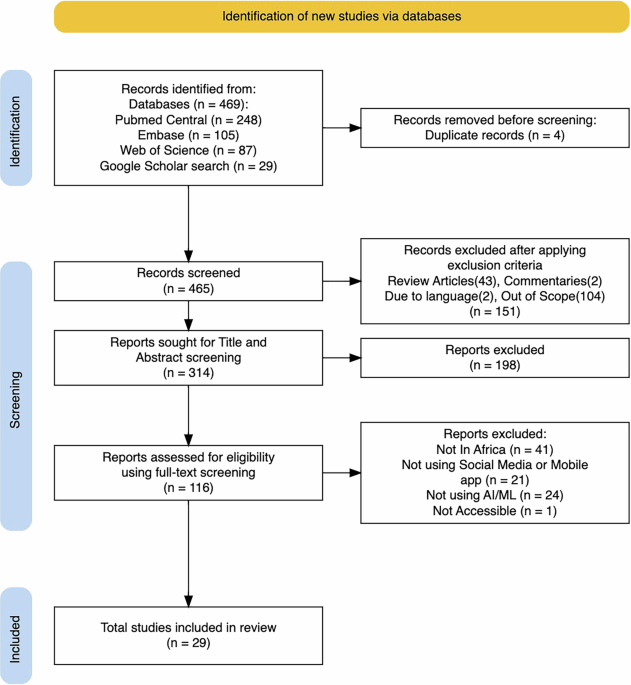
Tricco, A. C. et al. PRISMA extension for scoping reviews (PRISMA-ScR): checklist and explanation. Ann. Intern. Med. 169, 467–473 (2018).
Google Scholar
Parham, G. P. et al. Validation in Zambia of a cervical screening strategy including HPV genotyping and artificial intelligence (AI)-based automated visual evaluation. Infect. Agents Cancer 18, 61 (2023).
Google Scholar
Movahedi Nia, Z. et al. Off-label drug use during the COVID-19 pandemic in Africa: topic modelling and sentiment analysis of ivermectin in South Africa and Nigeria as a case study. J. R. Soc. Interface 20, 20230200 (2023).
Google Scholar
Maturana, C. R. et al. iMAGING: a novel automated system for malaria diagnosis by using artificial intelligence tools and a universal low-cost robotized microscope. Front. Microbiol. 14, 1240936 (2023).
Google Scholar
Kabukye, J. K. et al. Implementing smartphone-based telemedicine for cervical cancer screening in Uganda: qualitative study of stakeholders’ perceptions. J. Med. Internet Res. 25, e45132 (2023).
Google Scholar
Turon, G. et al. First fully-automated AI/ML virtual screening cascade implemented at a drug discovery centre in Africa. Nat. Commun. 14, 5736 (2023).
Google Scholar
Fredriksson, A. et al. Machine learning for maternal health: Predicting delivery location in a community health worker program in Zanzibar. Front. Digit. Health 4, 855236 (2022).
Google Scholar
Ogbuokiri, B. et al. Public sentiments toward COVID-19 vaccines in South African cities: an analysis of Twitter posts. Front. Public Health 10, 987376 (2022).
Google Scholar
Dacal, E. et al. Mobile microscopy and telemedicine platform assisted by deep learning for the quantification of Trichuris trichiura infection. PLoS. Negl. Trop. Dis. 15, e0009677 (2021).
Google Scholar
Gbashi, S. et al. Systematic delineation of media polarity on COVID-19 vaccines in Africa: computational linguistic modeling study. JMIR Med Inform. 9, e22916 (2021).
Bruzelius, E. et al. Satellite images and machine learning can identify remote communities to facilitate access to health services. J. Am. Med. Inform. Assoc. 26, 806–812 (2019).
Google Scholar
Kraemer, M. U. et al. Past and future spread of the arbovirus vectors Aedes aegypti and Aedes albopictus. Nat. Microbiol. 4, 854–863 (2019).
Google Scholar
Rosado, L., Da Costa, J. M. C., Elias, D. & Cardoso, J. S. Mobile-based analysis of malaria-infected thin blood smears: automated species and life cycle stage determination. Sensors 17, 2167 (2017).
Google Scholar
Fast, S. et al. Predicting social response to infectious disease outbreaks from internet-based news streams. Ann. Oper. Res. 263, 551–564 (2017).
Google Scholar
Oyebode, O. & Orji, R. Detecting factors responsible for diabetes prevalence in nigeria using social media and machine learning. In 2019 15TH International Conference on Network and Service Management (CNSM) 1–4 (Halifax, NS, Canada, IEEE, 2019).
Zhao, O. et al. Convolutional neural networks to automate the screening of malaria in low-resource countries. PEERJ 8, e9674 (2020).
Google Scholar
Oladeji, O. et al. Monitoring information-seeking patterns and obesity prevalence in Africa with internet search data: observational study. JMIR Public Health Surveill. 7, e24348 (2021).
Google Scholar
Yang, A. et al. Kankanet: an artificial neural network-based object detection smartphone application and mobile microscope as a point-of-care diagnostic aid for soil-transmitted helminthiases. PLoS Negl. Trop. Dis. 13, e0007577 (2019).
Google Scholar
Mejía, K., Viboud, C. & Santillana, M. Leveraging Google search data to track influenza outbreaks in Africa [version 1; peer review: 1 approved, 1 not approved]. Gates Open Res. 3, 1653 (2019).
Aiken, E. L. et al. Real-time estimation of disease activity in emerging outbreaks using internet search information. PLoS Comput. Biol. 16, e1008117 (2020).
Google Scholar
Nsoesie, E. O., Oladeji, O., Abah, A. S. A. & Ndeffo-Mbah, M. L. Forecasting influenza-like illness trends in Cameroon using Google Search Data. Sci. Rep. 11, 1–11 (2021).
Google Scholar
Olukanmi, S. O., Nelwamondo, F. V. & Nwulu, N. I. Utilizing Google search data with deep learning, machine learning and time series modeling to forecast influenza-like illnesses in South Africa. IEEE Access 9, 126822–126836 (2021).
Google Scholar
Tudor, C. & Sova, R. Infodemiological study on the impact of the COVID-19 pandemic on increased headache incidences at the world level. Sci. Rep. 12, 10253 (2022).
Google Scholar
Adamu, H. et al. Framing Twitter public sentiment on Nigerian government COVID-19 palliatives distribution using machine learning. Sustainability 13, 3497 (2021).
Google Scholar
Majam, M. et al. Utility of a machine-guided tool for assessing risk behaviour associated with contracting HIV in three sites in South Africa. Inform. Med. Unlocked 37, 101192 (2023).
Google Scholar
Maffioli, E. M. & Gonzalez, R. Are socio-demographic and economic characteristics good predictors of misinformation during an epidemic?. PLoS Glob. Public Health 2, e0000279 (2022).
Google Scholar
Potgieter, A. et al. Modelling representative population mobility for COVID-19 Spatial transmission in South Africa. Front. Big Data 4, 718351 (2021).
Google Scholar
link