



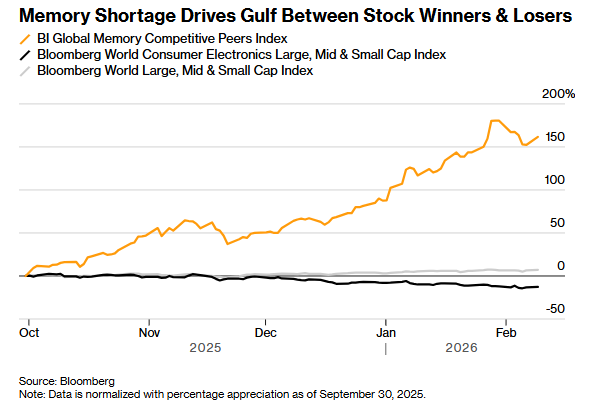
①The continuous surge in global memory chip prices over the past few months is creating a significant divide between winners and losers in the stock market; ②and investors may not yet see the end of this divergence in performance.
Cailian Press, February 10 (Editor Xiaoxiang) The continuous surge in global memory chip prices over the past few months is creating a significant divide between winners and losers in the stock market, and investors may not yet see the end of this divergence in performance.
From game console manufacturers like Nintendo, large PC brands to mobile phone makers, the share prices of numerous consumer electronics companies have plummeted due to concerns over profitability. Meanwhile, the share prices of memory producers are soaring to unprecedented highs. This has prompted fund managers and analysts to begin assessing which companies can secure supply, raise product prices, or redesign products to reduce memory chip usage, thereby finding the best way forward amidst this squeeze.


The question now is how much expectation has already been priced into the market?
Are risks still underestimated?
Vivian Pai, a fund manager at Fidelity International, stated that what remains underestimated is the risk regarding duration. Current valuations essentially assume that the disruption in memory chip supply will normalize within one to two quarters. However, we believe industry tensions could persist—potentially throughout the remainder of the year.
In recent earnings reports and conference calls, as companies frequently mention issues related to memory chip shortages and price increases, investors have been alerted.
Last Thursday, shares of Qualcomm, a smartphone processor manufacturer, fell more than 8% after it indicated that memory constraints would impact phone production. In Tokyo, Nintendo also saw its largest drop in 18 months last Wednesday after warning that shortages were pressuring profit margins.
Currently, the stock price of Logitech, a Swiss peripherals manufacturer, has fallen by about 30% from its November peak due to expectations that rising chip prices will dampen demand for personal computers. Meanwhile, the stock prices of Chinese electric vehicle and smartphone makers, from BYD to Xiaomi, remain sluggish amid concerns over chip shortages.
“In this earnings season, memory prices have jumped from being a background topic to becoming headline news,” said Charu Chanana, Chief Investment Strategist at Saxo Bank. “The market is generally aware that memory prices are rising and supply is tight – this is not new information, and I believe the market has already priced it in. However, the timeline for the supply constraints seems to be starting to come into question.”
Storage supercycle
Currently, dual concerns over demand and profitability are weighing on corporate outlooks, while U.S.-based hyperscale cloud service providers’ massive investments in artificial intelligence infrastructure may exacerbate the shortage of memory chips. The large-scale construction of AI infrastructure led by companies such as Amazon is shifting capacity from traditional DRAM to high-bandwidth memory.
This has given rise to what is being called a storage ‘supercycle,’ breaking the usual boom-bust cycle pattern seen in the supply and demand of memory chips.
Despite weak demand for end products such as smartphones and automobiles, spot prices for DRAM have surged more than 600% in recent months. Moreover, artificial intelligence is driving new demand for NAND flash and other memory products, pushing up costs in these niche markets.
Against this backdrop, memory chip manufacturers have become the biggest winners among technology stocks. Since the end of September, SK Hynix, a key HBM chip supplier to NVIDIA, has risen over 150% in the Korean market. Among general memory chip makers, Japanese storage company Kioxia has gained around 280% during the same period, while U.S.-based Sandisk has surged more than 400% on the New York Stock Exchange.
Jian Shi Cortesi, a portfolio manager at GAM Investments, stated, “Historically, memory cycles typically last three to four years. The current cycle has surpassed previous cycles in both duration and magnitude, and there are no signs yet of weakening demand momentum.”
She added that she is currently holding memory chip-related stocks on a long-term basis.
link